For team leaders, brokers & top producers.
20 homeowners who already said yes to the call.
Homeowners who want to sell, booked as real appointments — a set day and time, with your name on it. They're expecting you. You're not chasing anybody, and you've heard the recording of the call that booked it before you dial.
Here's one. Santa Fe condo, owner lives in Albuquerque.
Qualification call · 4:37 · redacted for the homeowner's privacy
"Are you still looking to sell this property?" — "Yeah."
"I listed it for 220 and I felt like that was a little high."
"Thursday at noon should be fine."
That's a stranger agreeing to a specific time with a specific agent about selling her house.
Not a form fill. Not a name off a scraped list. Not a shared lead going to three other agents in your zip while you all race to be first callback.
About the closest thing you'll get to cousin Larry calling to say his gym buddy wants to sell.
Somebody on your team has already asked if you've got anything for them
That's the actual problem, and it isn't really about money.
Buyer-heavy teams don't lose income first. They lose people. A good agent sits around for a quarter without a listing, starts taking calls from the brokerage down the street, and leaves — and you spend the next six months replacing someone you'd already trained.
Listings are the only thing that fixes that. Everything else is a stopgap.
Afra here. I run DealMachine OS. We book seller appointments, every day, at volume, in a lot of markets — for our own team and for the teams we work with directly.
We do one thing. This is it.
Why nobody else does this well
It isn't a secret. Every agent knows getting to homeowners before they hit the open market is the whole game.
What stops people isn't the idea. It's the middle.
Finding the right homeowners in your specific market. Reaching them the right way. Qualifying them honestly instead of checking a box to hit a quota. Reconfirming so nothing falls apart before the call. Positioning you — specifically you — as the person who's going to help.
Most people don't want to do that work. We built our whole operation around doing nothing else.
Six things have to be true
If any one of those isn't true, it doesn't reach your calendar. And one more, which is the part most vendors skip:
They have to agree to a call from you specifically, at a set time. Not "maybe someday." Not "sure, send me some info." They say yes to that appointment, and they know who's calling.
Some have a tenant lease to run out first, or a renter they want to give 90 days. When that's the case it's on the sheet before you dial. We don't hide it to make the appointment look cleaner than it is.
And if one wasn't actually qualified, we replace it.
Judge the calls yourself.
You get the full, unedited recording of the qualification call. Not a summary. Not ISA notes. The whole conversation.
The three on this page are redacted — that's for the homeowner's privacy, not yours. What lands in your inbox is the complete audio.
So you hear the reason, the personality, the hesitation in the middle, before you ever pick up the phone. Which means I have to show you the messy ones too.
Harder call · 8:28 · two houses on one lot, Montana
"At some point I'm going to obviously have to sell them. I'm not getting any younger."
"I've had them for a very long time… I would have to give an enormous amount of money to… capital gains."
"90 days, so she can go find somewhere new to live."
"No, I haven't sold anything in a long, long time."
That one's not a layup and I won't pretend it is. Real seller, real reason, real complications — the kind of conversation a good listing agent wins and a mediocre one loses.
Longer timeline · 7:11 · investor, tenant in place
"I really don't want to keep worrying about the property… property tax, property management, the whole nine yards."
"I'm in no rush. I'm pretty damn patient."
"Two could work perfect, actually. Yeah, sign me up for two." (agreeing to a 2 p.m. call)
I'm showing you that one on purpose. He's a six-month seller, not a 30-day seller — and you'd know that from the recording before you spent a minute on him. Some of your 20 look like this. You decide how to work them.
What actually lands on your end
Not a name and a number. This is a real one, redacted.
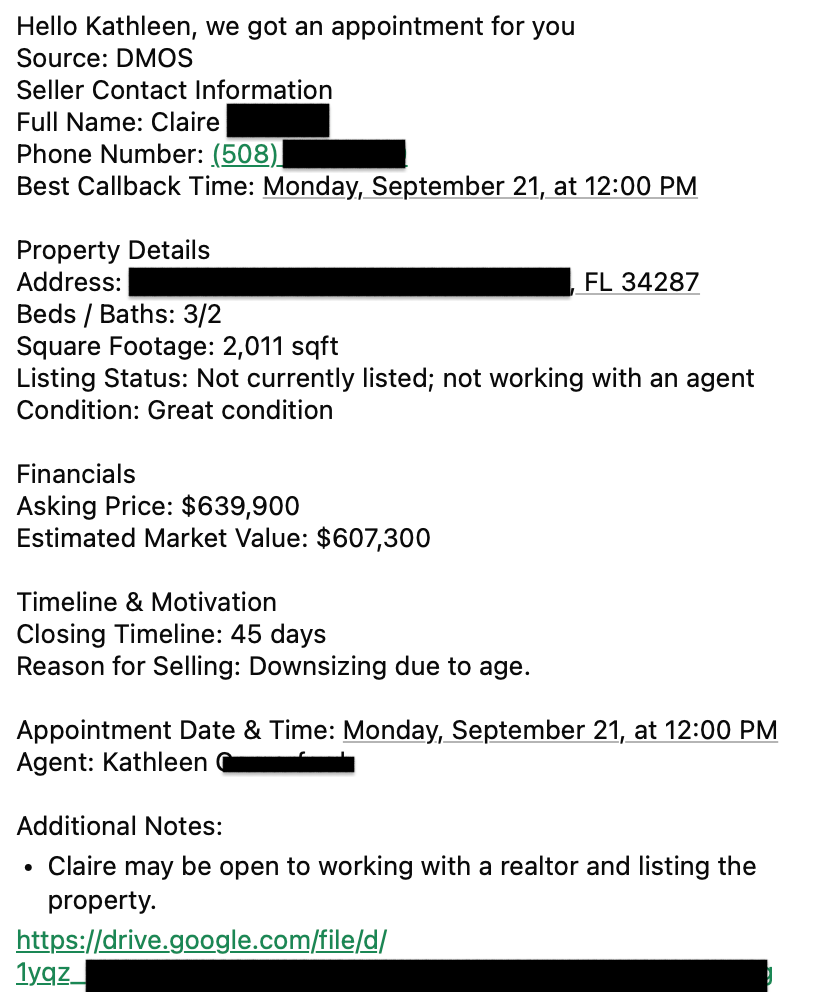
On that one the asking price sits about 5% over the estimate. You know it before you dial, which means you walk into the kitchen already knowing the conversation you're going to have.
Teams in the middle of it right now
Pulled from our private client group. Names and numbers redacted.
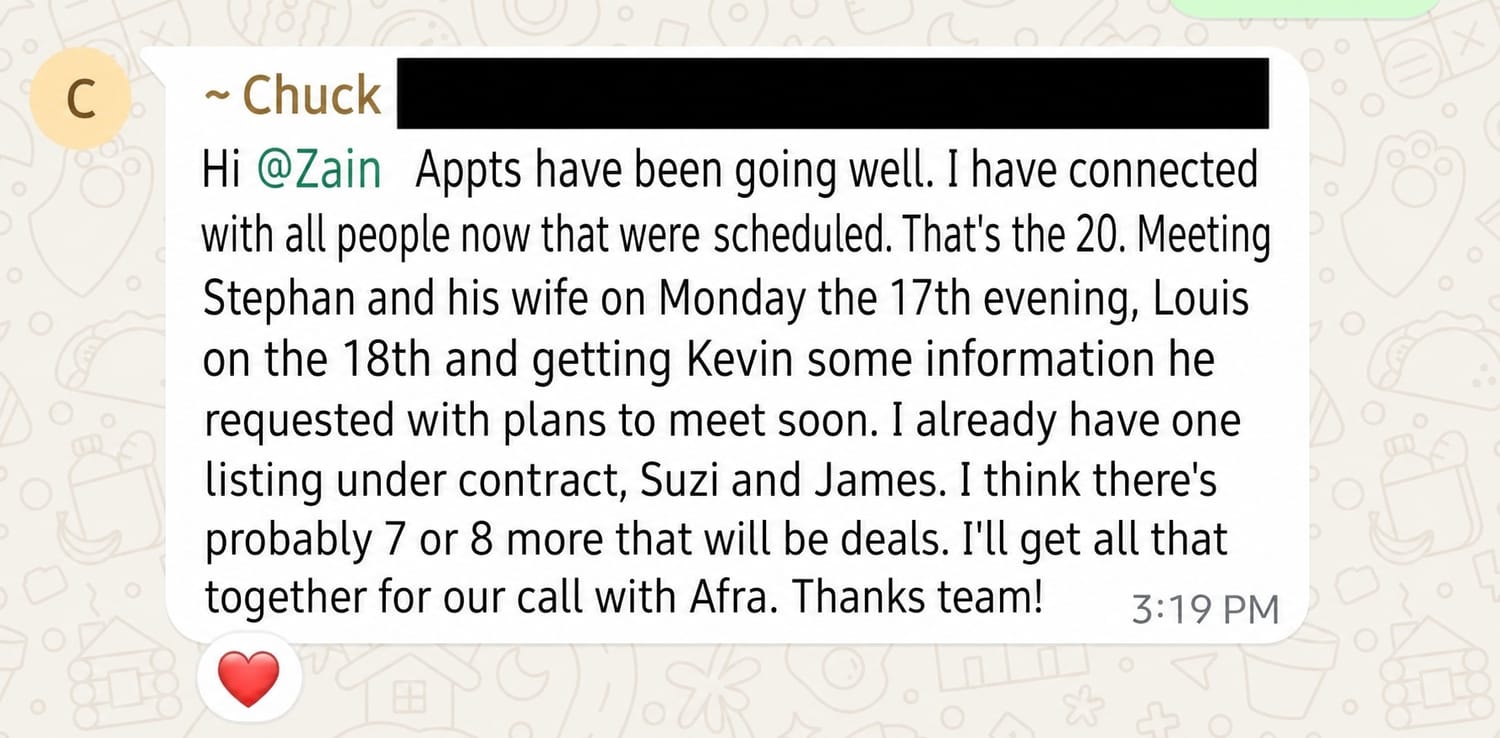
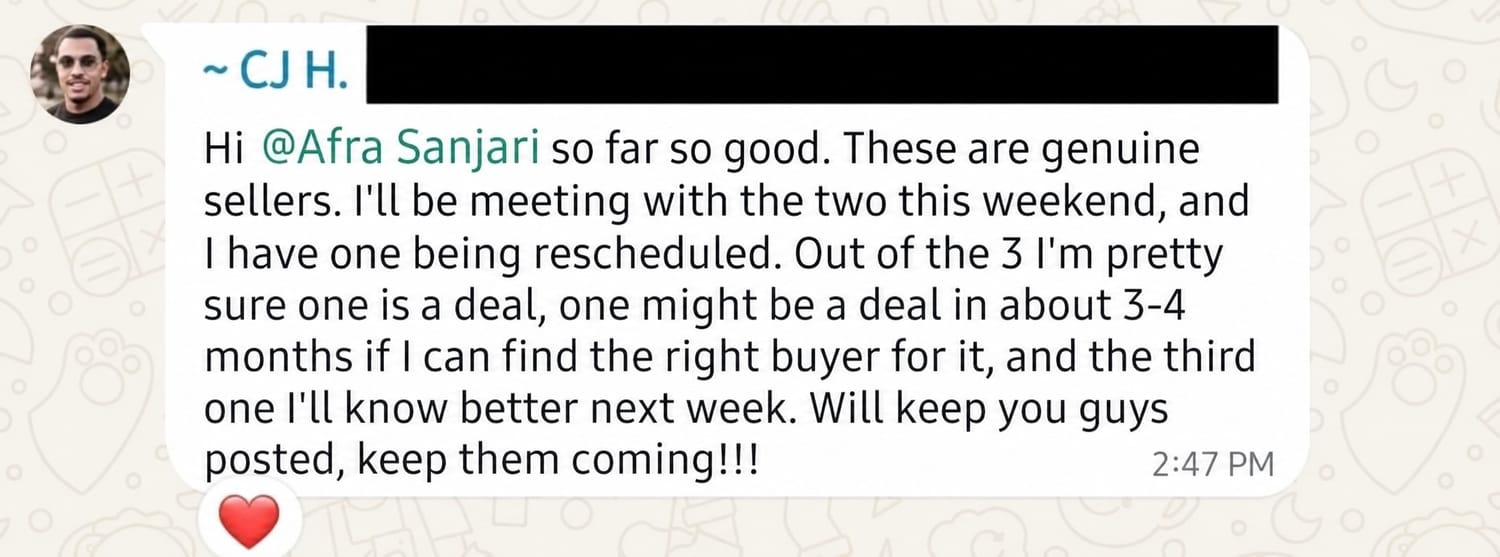
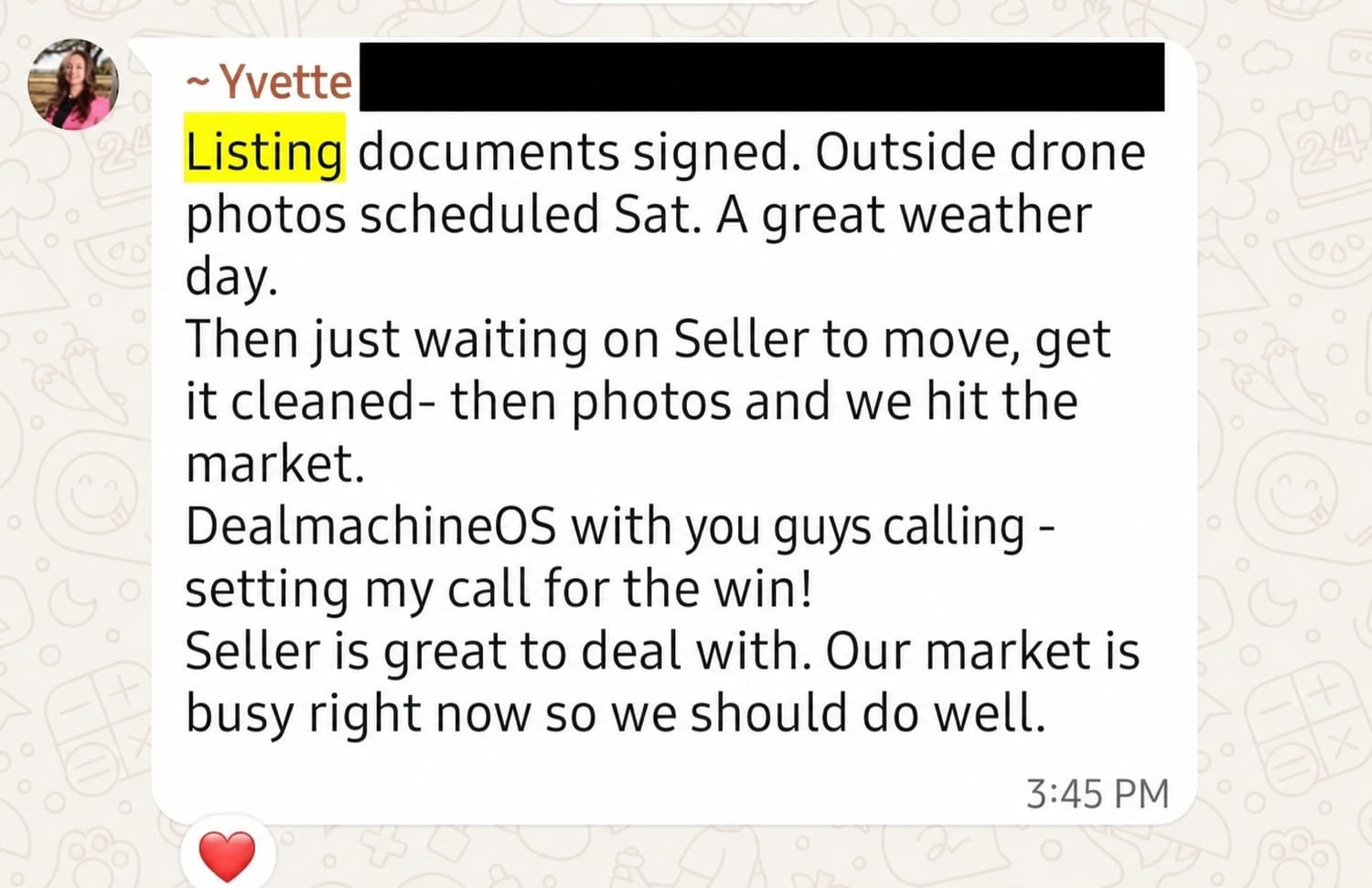
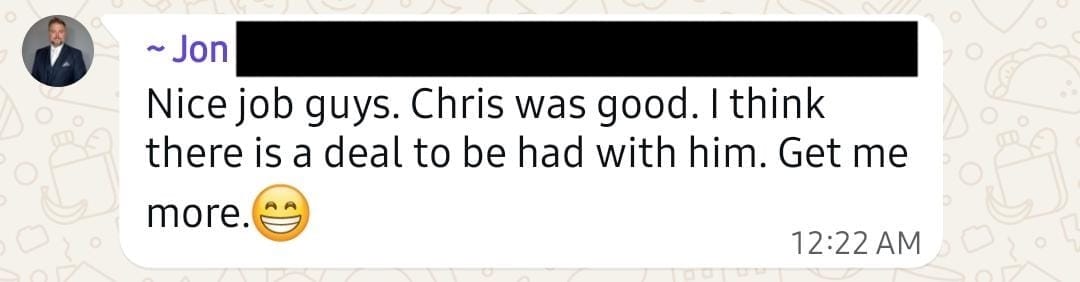
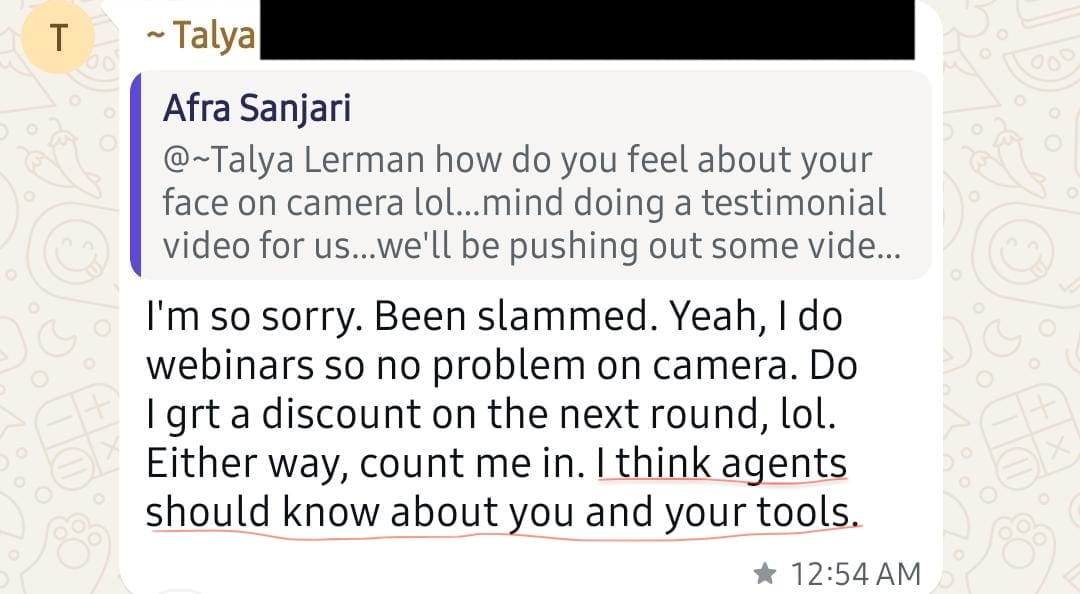
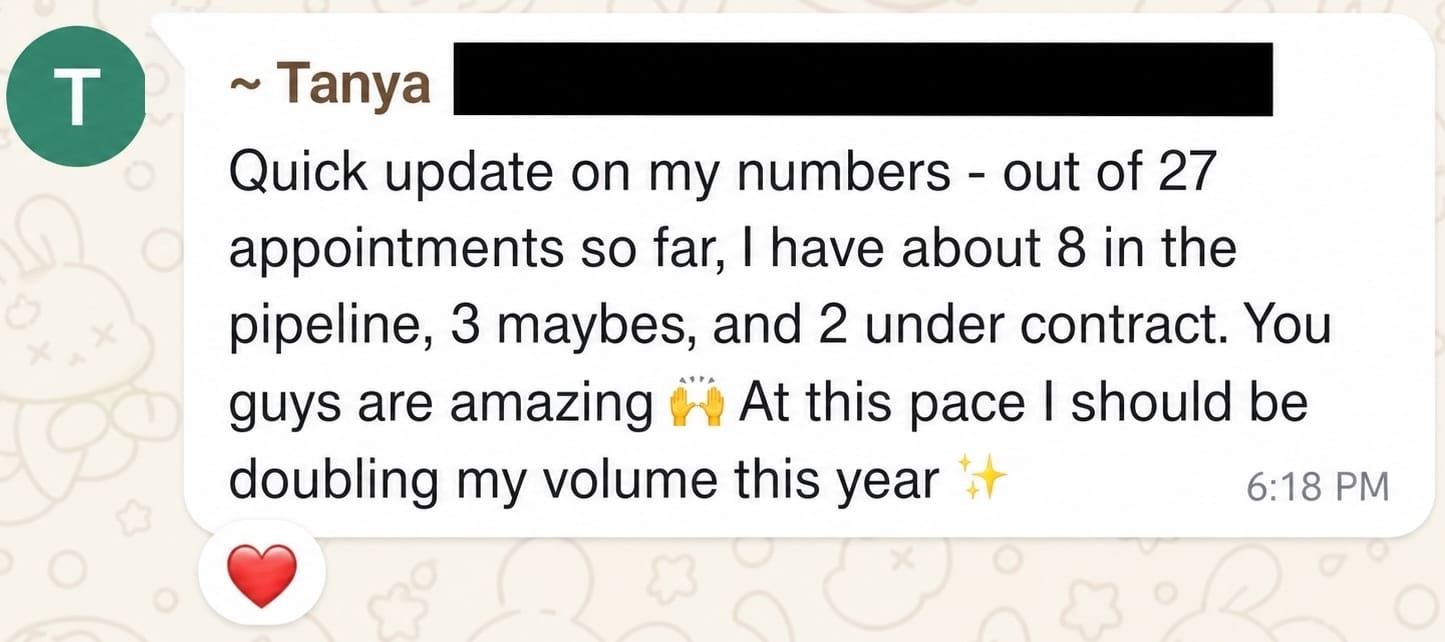
Individual experiences from teams currently running this. Results vary with market, team, follow-up and skill. Nothing here is a guarantee of income.
Talya runs $5M+ in volume in Palm Beach County, Florida, and is building her team. She agreed to say it on camera.
What $5,000 buys
20 exclusive, pre-qualified seller appointments, delivered over about 4 weeks.
- Each one booked into availability you set, at a time the homeowner agreed to, with your name on it
- The full unedited recording and detail sheet for every one, before you dial
- Exclusive — we never hand the same seller to another agent in your area
- A dedicated success manager on your account
- No-show protection. You call, leave a voicemail, send a text. Nothing back by end of day? Your success manager takes it from there — we call them back, confirm, and reschedule.
- If they've changed their mind, or one wasn't actually qualified, we replace it. You don't chase people who don't want to be chased.
- The Diagnostic Close Playbook — the same one our own team runs, covering all 10 ways a homeowner can exit a house
- One payment. No retainer, no contract, nothing renews.
$5,000. That's $250 an appointment. And you keep 100% of every commission.
Why $250, and why it doesn't move
A fair question: why $250, when a lead shop charges $350 for a name that has no idea who's calling?
Because that's just the price. It's $250 whether you take 20 or 200. There's no cheap trial that gets repriced once you're depending on it, and no volume tier to negotiate your way into — the teams taking the most off us every month pay exactly what you'd pay for your first 20.
You're paying for the work: a person on the phone, having a real conversation, getting a homeowner to agree to a specific time. That costs what it costs at any scale.
Break-even is one. The target is six.
Say a listing pays you $10,000 — national average sale price, 2.5% sell side. Use your own number if it's different. Passing these to agents on a split? Use your side of it; the math still works at half.
Here's the part I want you to read carefully.
One closing is not the goal. One closing is the floor — the point where this cost you nothing and you got paid for the month. If one deal is what you're aiming at, you're aiming at the wrong number and you'll be disappointed even if you hit it.
Across the teams we run this for, 20% to 60% of a 20 lands in the pipeline. We plan on 30%. Market, timing and your own close rate move that more than we do.
30% is the number to come in expecting.
Six deals in the pipe from twenty conversations. That's the average, not the ceiling — plenty of teams beat it.
If you run a 20 and only one closes, that's not a win, that's a signal. Either the market was wrong, the calls were handled wrong, or you weren't set up to absorb the volume. We'd look at all three on Zoom and I'd tell you honestly which it was.
So the question isn't whether $5,000 is a lot of money. It's whether you can take twenty conversations with homeowners who already want to sell and turn a third of them into deals. If a third sounds high to you, we're probably not a fit. If it sounds like a normal month, the only thing left to decide is how many you want.
The first closing usually covers the whole thing. Across the teams we run this for, we've tracked about $14 back for every $1 spent — measured after deals actually close, not the day you sign up. That's our number across our book of business, not a promise about yours.
What you're already paying for seller appointments
You're not deciding whether to spend money on this. You're deciding where it goes.
A referral program
−$3,500 to $4,000 per closing, every closing35–40% of a $10,000 check, for a lead that was never exclusively yours. Two closings and you've paid more than this costs. On the third they're back for another cut.
Twenty appointments here
$5,000 once then nothingExclusive. Every commission after that is yours, whole. No contract, no renewal, no piece of your deal.
The other two options look worse the closer you get. Lead-shop appointments run $300 to $400 and the homeowner often has no idea who's calling — twenty of those is $7,000 for unqualified names. A full-time ISA is $4,000 to $5,000 a month loaded, before training, management and turnover, and takes 90 days to get good.
You're already paying for seller appointments. This is the version where the seller knows you're coming.
What you're actually risking
Nothing, until we've talked. You apply, I read it, and if it's a fit we spend 15 minutes on the phone. No money moves before that call.
Then once you're in: if an appointment wasn't actually qualified, we replace it. If they no-show, we chase them down and reschedule — you don't. If they've changed their mind, we replace it. No contract, no retainer, nothing renews. You pay once and you decide what happens after.
What you're risking is four weeks of your team's calendar, and one payment that's smaller than what a referral program takes off your next two closings.
You don't know me from Adam, and paying five grand to a stranger on the internet is a dumb way to spend money. I'd tell my own sister not to do it. So don't — send the application and we'll talk first. I might tell you no.
See if you're a fit →15 minutes. I'll tell you whether your market's open and answer whatever you've got. If it's not a fit, I'll say so.
Your first call with the homeowner
Whether you take these yourself or hand them to someone on the team, that's your machine. Your call.
You're not calling to pitch a listing in the first five minutes. You're calling to build quick rapport and set a time to see them in person, at the property, at the kitchen table. That's where you diagnose.
A prescription before a diagnosis is malpractice for doctors. Same rule here. Diagnose first, then give them the option that's actually in their best interest, not the one that's easiest for you.
Most of these become listings. That's the honest version. Some won't — there are about 10 ways a homeowner can get out of a house and listing is only one of them, which is exactly why you get the playbook covering all 10.
Why everyone starts at 20
Twenty is the smallest number that tells the truth. Five is a coin flip — you can get lucky or unlucky and learn nothing. A hundred, before either of us knows your numbers, is me setting you up to drop half of them.
Twenty over four weeks gives us both a real read: how many landed, how many are for-sures, how many are maybes, how many will take a miracle. That's when we have trend lines, and that's when we know whether to hold you at 20 a month, open up volume, or tell you honestly to sit tight.
It's also how you find out without ripping out anything you're already running.
We're good at one thing: getting sellers onto a calendar. We're not good at herding twenty different agents — that's your job, running the team. It's far easier for us to build real volume with one team that can absorb what we generate than to spread thin across a dozen solo agents.
Who should sit this out
Most teams land 4 to 7 deals in the pipeline from a first 20. Tracked out 6 or 12 months it runs higher. Could something close in 30 days? It happens — but most run 30 to 120 days, some longer.
If you need a check inside 30 days for this to count as working, this isn't your move right now. Not because you're bad at your job — because you're not set up for volume yet, and that's a different problem than the one we solve.
Read this part twice, because I want the expectation right.
These are strangers. Qualified strangers who agreed to a specific time with you — about the best thing available short of a direct referral — but still people you've never met.
You have to be experienced and confident turning a stranger into a signed seller. If that's not you yet, sit this one out. You'll hate the calls, they'll hate talking to you, and we'll both waste a month.
Why this isn't pay-at-close
We can't take a referral fee. I'm not a licensed agent, and getting licensed in 50 states to take a cut of your closings makes no sense for what we do.
So you pay once, upfront, and I never touch a dollar of your commission. If you only work with vendors who get paid at close, we're not a fit, and that's fine.
The questions I get every time
What if you're not in my market?
Put every city and county you'd actually take these in on the application. If we're not there yet I'll tell you straight on the 15 minutes whether we can build it and roughly how long that takes. I'd rather say no than take your money and stall.
Is $250 introductory pricing?
No. Same price at 20 or 200. It's never gone up on a client mid-relationship and there's no volume tier.
How fast do 20 arrive, and will they land while I'm showing?
Roughly five a week over four weeks, and nothing gets booked outside the availability you give us. If your Tuesdays are gone, Tuesdays don't exist.
What does the homeowner think is happening?
That a specific local agent — you by name, or your team — is calling at the time they agreed to, to talk about selling, and that the conversation covers all the ways they could exit the property rather than just a listing. No bait, nothing you have to walk back in the first minute.
Are all 20 ready to list next week?
No, and anyone telling you otherwise is selling you something. Most are 1 to 6 months out and some have a lease to clear. You'll know which is which from the recording and the sheet before you dial — that's the entire point of sending them to you.
Do I have to learn software?
No. Despite the name there's nothing to log into. Appointments land on your calendar and in your inbox with the sheet and recording attached.
Is this a subscription?
No. One payment for the 20, no contract, nothing renews. What happens after is a conversation, not a default.
Can you run this for two teams in my metro?
Barely, and not for long — past a point we're competing with ourselves for the same homeowners. If someone in your market takes regional exclusivity, we're closed there until they stop.
You said no. Can I come back?
Yes, and plenty do. "No" usually means "not in the next four weeks" or "not in that market yet," not "never."
Who's behind this
DealMachine OS is a team: people on the phone with homeowners every day, a success manager on every account, operators and managers at every node, and me running it. I've spent 20+ years growing businesses — consulting for Cisco, Audi, Harley-Davidson and Universal Music, and on the property side for CBRE and Cushman & Wakefield. I've helped grow two residential brokerages, and consulted with hundreds of agents. I'd rather deal with operators than solo-agents, which is roughly how I ended up here.
Longer version, if you want it before you fill anything in: afrasanjari.com.
If you can run 20 of these in the next 4 weeks, send this.
I read every application myself, and I only take on teams I'm confident will do well with this. That's not modesty — it's how we protect our close rates and our reputation.
If it's a fit I'll email you personally to set up 15 minutes. If it isn't, I'll tell you that too, and why.
Who gets on these calls first?
In the next 4 weeks…
If it's a fit you'll get 15 minutes with Afra — usually within one business day.
If you're just browsing, don't submit it. We'll park it.
P.S. Solo on a team? Don't submit this.
Forward it to your team leader. Sit on it and you get a couple of appointments you can't scale while the team is still light on listings. Forward it and you just walked into the room with something the whole team can run — and you're the one who brought it.
P.P.S. Every appointment is exclusive.
We never give the same seller to another agent in your area. And if you want regional exclusivity — we don't work with anyone else in your markets and you take everything we generate, ongoing — that conversation happens after your first 20. Not before. I need to see your numbers first.